
Right before Mardi Gras season begins every year, Ann Bartlett Hearin’s phone starts ringing more often.
Members of her court from 1958 start calling to make plans for their reunion, and other former queens get in touch with her about making …
This item is available in full to subscribers.
Please log in to continue |
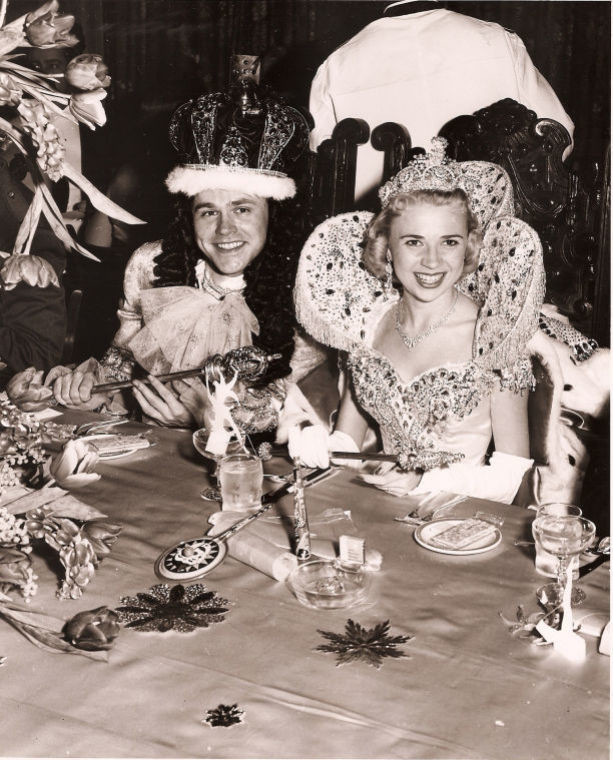
Right before Mardi Gras season begins every year, Ann Bartlett Hearin’s phone starts ringing more often.
Members of her court from 1958 start calling to make plans for their reunion, and other former queens get in touch with her about making arrangements to attend the past queens’ luncheon.
The parties, tradition and social scene resurrect memories of her reign as Mobile’s Mardi Gras queen 55 years ago. At 75 years old, she can still see the glittering robes she wore, taste the fine food and feel the weight of the long train she pulled behind her during so many public appearances.
Hearin, whose father worked for the Mobile Press-Register and was involved in the Mobile Carnival Association, always dreamed of becoming Mardi Gras queen.
“When I was little, we would catch the bus downtown to my daddy’s newspaper office, and we’d see the parades at least twice,” she said. “It was in your blood. To grow up and be queen of the Mardi Gras was spectacular. It’s just a memory you never erase.”
Hearin said she found out about her royal status at least a year in advance — it took that long to make all of her robes and dresses.
At the time, 20-year-old Hearin was studying at Sweet Briar College in Virginia. In the fall of 1957, however, she took a break from school to be able to fulfill all of her duties as queen — duties that started as early as September.
“I didn’t go to college the year I made my debut,” she said. “From September to February is too long. It doesn’t last as long now, but it was different then.”
Until the week of Mardi Gras, obligations mostly consisted of what seemed like constant parties and dances, she said. But once she began making public appearances in her robes, especially on Lundi Gras and Fat Tuesday, Hearin said she began to actually feel like royalty.
“It was a time of carefree happiness, but also a time of responsibility to be queen of your city, for the people,” she said. “You felt like a queen to the city of Mobile. When you were riding on the float that Tuesday, you acknowledged children, adults, grandmothers — you wanted everybody to know they were part of your reign. You were queen to everyone, and you tried to act accordingly, with dignity and grace.”
One of the most thrilling experiences, she said, was riding in a limousine with a police escort to the coronation ball at the Fort Whiting Auditorium the Saturday before Mardi Gras. When it was her turn to debut at the coronation, she walked up a set of stairs onto an elevated runway, dragging the heavy train along the way.
The day after the 1958 Mardi Gras, Hearin was full of joy, but was also exhausted and sick.
“I was invited by the Carnival Association to take a bouquet of flowers to some visiting celebrity coming into to Mobile, but I didn’t have a voice or anything,” Hearin said. “The weather was freezing cold when I was on the float, so I got laryngitis. And I had bruises on my shoulders from the train.”
After her reign, Hearin went on to teach ballet for several years before moving to New York City to work for Vogue Magazine.
She quickly lost that royal feeling when she joined the ranks at the prestigious fashion magazine.
“The executive secretary of the company at that time was a Sweet Briar classmate of mine, and she said, ‘Just remember darling, everyone is dispensable,’” Hearin said. “In other words, ‘Just because you might have been who you are, it doesn’t mean we can’t fire you in a minute.’ Vogue came first. You were a drop in the bucket.”
Hearin worked first as assistant fabric editor, where she forecast the trends in color and texture, and then she became merchandising editor, traveling across the country to work with stores to match Vogue’s forecasting with their merchandise.
“You might say, ‘Vogue says: this is the season of black and white,’ and everybody would have black and white,” she said. “You did a little bit of everything at Vogue Magazine. The last two years were really exciting because I traveled all over the country. One time I spent three weeks in Texas and visited 17 cities.”
After five years at Vogue, Hearin moved back to south Alabama, taught dance again and then opened her own store, Ann’s Country Boutique in the Old Battles Village area.
Hearin said she is glad she is still able to participate in Mardi Gras every year. Although much has changed, the most important traditions remain.
She is happy Mardi Gras celebrations have extended into Baldwin County, and she likes that it seems to be more inclusive to outsiders.
“I think everyone should get to enjoy it,” she said. “That’s what it’s all about”
But Hearin does miss a few parts of the older Mardi Gras celebrations.
“One thing I do miss is the mules pulling the floats, and the flambeaus (kerosene lamps),” she said “You never knew when the mule was going to go or not going to go.”
No matter what year it is, however, the spirit of Mardi Gras is the same.
“It’s in your blood,” she said. “It’s kind of an intangible. It’s happiness, it’s revelry, it’s fun, its gaiety — it’s a privilege.”


