
FOLEY, Ala. — Note: In this, The Foley Onlooker’s 100th year, we will from time to time write stories designated as “Centennial” stories. These will be on subjects that have continued to impact the citizens of this area over the course of …
This item is available in full to subscribers.
Please log in to continue |
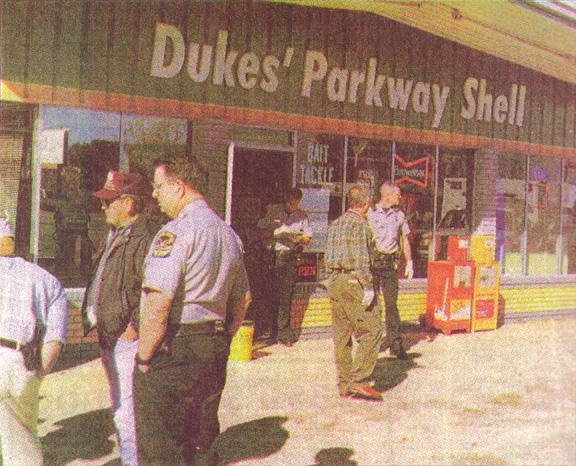
FOLEY, Ala. — Note: In this, The Foley Onlooker’s 100th year, we will from time to time write stories designated as “Centennial” stories. These will be on subjects that have continued to impact the citizens of this area over the course of this newspaper’s long history.
In the 100-year history of The Foley Onlooker, it is doubtful any local incidents impacted the South Baldwin community more than did the separate stabbing deaths of two convenience store clerks in Foley in December 1997.
For one, it was the brutality of the crimes.
Nancy Dukes: stabbed 40 times.
Linda Morton: stabbed six times.
For another, it was the calendar. The incidents came between Thanksgiving Day and Christmas Day. The holiday season in South Baldwin turned into one of shock, fear and grief for many as a result of the deaths.
As the City of Foley closed for Christmas Day in 1997, a memorial service for the victims was held Christmas Eve at Foley Middle School gymnasium complete with a police color guard. Commenting then on the unusual day and time for the service, then state Sen. Albert Lipscomb of Magnolia Springs said these were “unusual times.
“In my few short years I’ve never experienced anything like this in our community,” he said.
It was a feeling shared by many.
A week before the memorial service was held an evening press conference was held in Foley Municipal Courtroom, located then on North Alston Street. Among those on hand were members of the dead women’s families.
At that press conference it was announced that two capital murder warrants had been signed against Calvin Lewayne Stallworth, then 27, of 5th Avenue in the Aaronville neighborhood. After that press conference, information began to flow: A knife had been recovered at Stallworth’s apartment and blood-stained clothing as well.
David Whetstone, who was district attorney at the time, said that he would seek the death penalty if Stallworth was convicted. On Oct. 15, 1998, Stallworth was convicted on both capital murder counts.
Calvin Stallworth is today on death row at Holman Correctional Facility in Atmore. He has been there since Nov. 19, 1998.
Dukes’ Parkway Shell, the family-owned business where Nancy Dukes worked and died, is no more. The same is true for the Diamond Food Mart where Linda Morton worked and died.
Yet, some of the evidence from the Dec. 4 and Dec. 14, 1997, crime scenes might be reevaluated again. A Baldwin County Circuit Court judge has cleared the way for an evidentiary hearing that could conceivably prove Calvin Stallworth’s innocence. So believes a high-profile national law firm doing pro bono death penalty litigation for Stallworth.
A status conference will be held Dec. 18, 2008, in Bay Minette regarding the law firm’s Rule 32 petition filed on Stallworth’s behalf. On June 15, 2009, a final hearing on the Rule 32 petition will be conducted. At some point following that hearing Judge James Reid will make a ruling.
Much of the law firm’s contention is based on something that was in abundance in Foley during December 1997: blood.
DEC. 4, 1997
That Thursday morning was a bright, sunny one in South Baldwin.
At 9:37 a.m., Foley Police Department received a call about a stabbing and robbery at Dukes’ Parkway Shell, a well-known gas and food stop on Ala. Highway 59, just south of Baldwin County Road 12. A customer found Nancy Dukes.
At approximately 10:20 a.m. investigators from the Baldwin County Sheriff’s Office arrived at the scene to assist Foley police in gathering evidence. Over the next two weeks a hundred law enforcement personnel from many agencies would be focused on Foley.
A $5,000 reward was immediately offered for information leading to the arrest and conviction of the person(s) responsible for Nancy Dukes’ death, the first homicide of the year in Foley. The reward figure would climb in the days ahead.
Foley police received approximately 250 calls and potential tips the following week. Four suspects — described at the time as two males and two females from Foley, Fairhope and Gulf Shores — were held by Foley police, then released due to lack of evidence.
On the morning of Dec. 11, over 1,000 vehicles were stopped along the four lanes of Highway 59 in front of Dukes’ Parkway Shell as police officers conducted a roadblock and asked motorists if they were traveling that route between 9:15 a.m. and 9:35 a.m. on Dec. 4, the day Nancy Dukes was killed. By Dec. 11, the reward had risen to $15,000.
DEC. 14, 1997
That Sunday was overcast, cold and biting.
At approximately 1:12 p.m., a customer entered the Diamond Food Mart at busy South McKenzie Street and Michigan Avenue and found the cashier, Linda Morton of the Loxley area, stabbed to death.
At 4:35 p.m. a van from the Alabama Department of Forensic Sciences in Mobile arrived and removed Morton’s body.
At 6 p.m. a press conference was held at Foley Police Department during which then Mayor Tim Russell asked the citizenry to support the efforts of law enforcement and help keep spirits up in the city.
Whetstone, the district attorney, said a criminal task force would be formed to investigate the Dukes and Morton homicides. That task force would eventually include federal and state agencies as well as county and municipal, the largest task force ever assembled in Baldwin County for such a purpose.
An “aberration” is what Whetstone called what was taking place in Foley.
The reward money now totaled $18,000. By Dec. 16 the reward was $18,000 for information leading to an arrest and conviction in Nancy Dukes’ death and $10,000 for Linda Morton’s.
AFFIDAVIT
The day after the Dec. 17, 1997, press conference where authorities announced Calvin Stallworth’s arrest, Stallworth appeared before then District Court Judge Robert Wilters. He was appointed two attorneys for legal defense and was denied bond.
According to an affidavit filed at that time, Stallworth admitted to being at both convenience stores right after the stabbings. He also admitted to taking money but did not admit to committing the murders.
Testimony during Stallworth’s trial in 1998 revealed that $400 to $600 was missing from the cash register at Dukes’ Parkway Shell. An audit at the Diamond Food Mart revealed a shortage of $934.
The affidavit also said Stallworth, who was unemployed, had approximately $230 on his person when he was arrested Dec. 15, 1997, for parole violation. He admitted to spending more than $200 the day before, the affidavit said.
After Wilters read the charges relating to Nancy Dukes’ murder and began reading ones relating to Linda Morton’s, Stallworth fainted and had to be revived by paramedics.
A Baldwin County grand jury would indict Stallworth on two counts of capital murder in January 1998. He would be convicted on both counts in October of that year. On Nov. 18, 1998, he was sentenced to death by electrocution. The jury voted 10-2 in favor of the death penalty on each conviction.
In September 2001 the Alabama Court of Criminal Appeals affirmed Stallworth’s convictions but remanded the case and ordered the sentencing court to address a number of issues. In March 2002 the Court of Criminal Appeals remanded the case a second time due to uncorrected errors in the sentencing orders. In January of the following year the Appeals court affirmed Stallworth’s two death sentences.
In June 2003 the Alabama Supreme Court denied Stallworth’s petition for a review of his case. In September of that same year the U.S. Supreme Court denied a writ Stallworth filed with the court.
“OVERKILLED”
Sonnenschein Nath & Rosenthal LLP are a national law firm with hundreds of attorneys in 13 U.S. cities. One of those attorneys, Jerome T. Wolf of Kansas City, Mo., declined to comment in a July 30, 2008 e-mail about the pro bono work Sonnenschein is doing on behalf of Calvin Stallworth. He noted they are in the “midst of a Rule 32 proceeding and therefore feel that it is not appropriate to comment at this time.”
That Rule 32 petition — “ineffective assistance of counsel” — is what Judge James Reid will rule upon next summer. Sonnenschein’s Web site notes that on May 10, 2007, firm attorneys “won a last ditch effort to challenge Mr. Stallworth’s conviction” when Reid agreed to an “evidentiary hearing on several issues,” one of which is a “novel form of testing blood residue.”
In a document submitted to the court on Dec. 7, 2006, in response to the state’s objection to what is called “EDTA testing,” Wolf writes, “Nancy Dukes’ blood was likely planted on Stallworth’s jacket. Only one smear of blood was found on the jacket, an inch from the cuff on the inside of an elastic sleeve — but Mrs. Dukes was stabbed over forty times.”
Nancy Dukes was “overkilled” in Wolf’s words, and the violent nature of her death would have left her killer covered in blood, he writes in his response.
Thus, “it is inconceivable that just a tiny amount of blood would have ended up on Stallworth’s clothing, and on the inside of an elastic sleeve at that.”
Wolf also notes blood was drawn from Nancy Dukes for use in DNA testing. Since Alabama forensics personnel used “purple-topped tubes” containing an acid referred to as EDTA to preserve blood samples, testing that reveals EDTA in the bloodstain on Calvin Stallworth’s jacket would indicate the blood came from that sample, Wolf argues.
According to Wolf in paperwork submitted to the court in connection with the Rule 32 proceeding, Sonnenschein attorneys make three specific claims as regards ineffective assistance of counsel, namely, failure to perform an EDTA test on the blood found on Stallworth’s jacket; failure to do DNA testing on “residue” under the victims’ fingernails and on hair fibers found at the crime scenes; and failure to secure the testimony of a blood splatter expert.
Whichever side Judge Reid’s ruling favors next summer, an appeal by the other side is almost a certainty. Thus, what happened in Foley nearly 11 years ago, and the man who today sits on death row sentenced in connection with two of the most infamous crimes in county history, could be in legal proceedings indefinitely.
Sonnenschein attorneys feel that further investigation and analysis of certain evidence will prove Calvin Stallworth’s innocence.
David White was a corporal with Foley Police Department in 1997 and the department’s new narcotics investigator. He is a lieutenant today and FPD’s lead investigator.
Asked if he believes the right man is in prison for the deaths of Nancy Dukes and Linda Morton, he answers quickly and with a single word: “Absolutely.”


