
William Thompson always liked art as a child, but he decided to become an engineer instead.
And not just any engineer — Thompson spent 30 years in aerospace engineering, first working on autopilots and flight management systems and then moving …
This item is available in full to subscribers.
Please log in to continue |
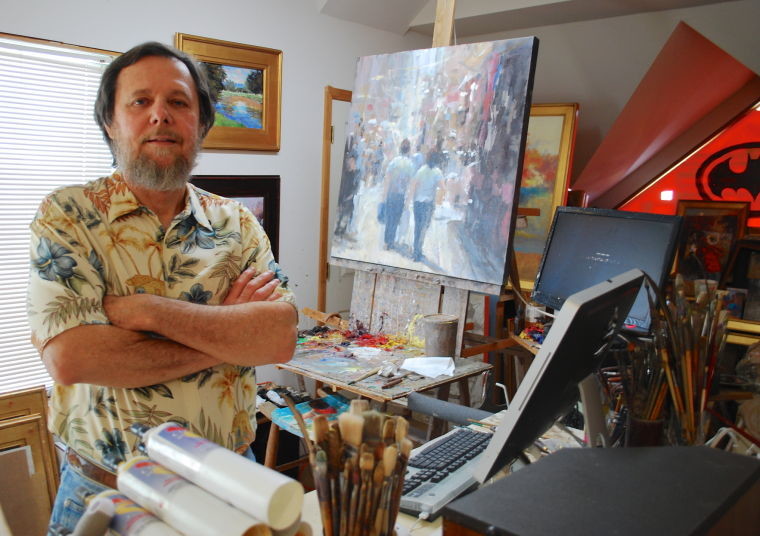
William Thompson always liked art as a child, but he decided to become an engineer instead.
And not just any engineer — Thompson spent 30 years in aerospace engineering, first working on autopilots and flight management systems and then moving into interplanetary spacecraft design.
But after being intimately involved in two missions to Mars, Thompson decided it was time for a change.
“I was always interested in art, but was told aerospace engineering was the future,” he said. “And it turns out, in the 60s, it was. But I decided I wanted a different challenge.”
And he chose painting.
“I came here (Fairhope), and we built this house, and I started learning about art,” he said. “I'm self taught, mainly.”
Thompson said he has enjoyed switching gears since moving back to south Alabama in the early 90s.
“I guess I'm sort of right brain left brain — you need both,” he said. “My artistic side was really helpful in troubleshooting in engineering, and my analytical side has been very helpful in establishing a career in art.”
Instead of being purely creative, Thompson recognizes the science of art, which has not only helped him learn how to paint, but also has enabled him to teach others.
“I applied my analytical skills to what makes a good painting,” he said. “Why does one painting attract me and another one doesn't? So I started writing it all down, and now, when I teach workshops, I teach the science of painting, which is shapes, values, edges and color theory.
“If you understand the science and fundamentals of painting, you can paint in any style you want. If you know that, then you can add the emotional content, which is you yourself, into it. But only after you've mastered the fundamentals.”
Thompson is known for his impressionist paintings. He paints with oil on canvas, linen or prepared board, and he's a stickler for archival procedures, buying materials and using methods that will ensure his paintings last for a century or more.
Thompson enjoys painting landscapes, but his work often has a human subject, too. But in all his paintings, there is room for the viewer's imagination to wander.
“The analytical side of me says, 'It need a subject matter,' but my artistic side says, 'Don't tell them too much,'” he said. “Paint the dog, not the fleas. It creates mystery, and that mystery allows the viewer to put themselves in the painting.”
Although Thompson often takes an analytical approach to painting, he said he doesn't follow rules when it comes down to the actual process of putting paint on the canvas.
“I tell my students, 'Run from the rules,'” he said. “I just get into the zone when I'm painting. I go into the zone, and I start moving paint. From there, I see something in the paint, and I try to bring it out.”
Thompson will be one of the local artists displaying his work at the Fairhope Arts and Crafts Festival, March 15–17. He has been part of the festival for the past 15 years, and he won the award of distinction in painting in 2012.
And although his paintings have been recognized by the judges in the past, Thompson said his favorite aspect of the festival is interacting with the people who stop to look at his paintings.
“One of the reasons I do the festival is I experiment a lot, and it's my one opportunity to have one-on-ones with the public and potential customers and to get their feedback,” he said. “Somebody can walk into my booth and look at my work, and they don't have to say a thing — I can tell they either like it or they don't. It gives me feedback I need, and I enjoy talking to people and getting another side of the art world that I don't get through galleries.”


