
FAIRHOPE, Ala. — Five years ago, the Fairhope Environmental Advisory Board started a research and educational project regarding termite problems in the area.
The effort was prompted by the discovery of Formosan subterranean termites in …
This item is available in full to subscribers.
Please log in to continue |
FAIRHOPE, Ala. — Five years ago, the Fairhope Environmental Advisory Board started a research and educational project regarding termite problems in the area.
The effort was prompted by the discovery of Formosan subterranean termites in Fairhope.
“It’s been a while since we did the research and published the brochures, and we thought this might be a good time to raise awareness about the issue again, so people don’t forget,” said Ron Heveran, a current member of FEAB who was chairman of the group in 2003. “It’s nothing to be frightened about, but you should be concerned. If you don’t, you’re taking a risk.”
Heveran said copies of the brochure about preventing and controlling termites are available at City Hall and the Public Works building.
Formosan termites, which are more aggressive and destructive than native subterranean termites, first arrived in the the United States after World War II from the South Pacific where the species originates, according to the USDA’s National Formosan Subterranean Termite Program in New Orleans.
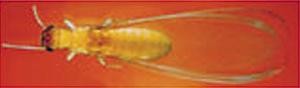
Formosan termites swarm in the air from May through July, said Xing Ping Hu, an Auburn entomologist who assisted FEAB in its research in 2003.
She also visited Fairhope in 2001, when the first colony of Formosan termites was found in the city in a tree and nearby wooden shed on Bay Breeze Lane. The tree and structure were cut and burned in place, she said.
“Every year since then we have seen an increase in incidents in a number of Alabama counties, including Mobile and Baldwin,” Hu said this week. “Formosans have much larger colonies than native species, with several million compared to a couple hundred thousand. They also may attack living trees and establish nests or colonies in attics and walls without need for ground contact, making them hard to detect.”
In 2003, several FEAB members and local public officials traveled to New Orleans to meet with the USDA’s Formosan research scientists for advice on dealing with the species in Fairhope.
“We supported their monitoring efforts, providing the sticky pads that collect the species and gave them advice on how to deploy them,” said Alan Lax, who leads the project in New Orleans that was established in 1998. A widespread infestation of Formosan termites in the French Quarter area there led to the formation of the research group.
During the May-July swarming season in 2003, the Fairhope environmental group placed 428 “sticky card” traps at 109 locations around Fairhope, and Formosan termites turned up at 73 of the sites on 125 cards, according to press accounts at the time. Hu concluded that 79.35 percent of the sites tested had some infestation of Formosan termites.
Since that time, there has been no hard data collected regarding Formosan infestation in the state, Hu said. Conclusions about their increasing incidence are based on anecdotal evidence from agricultural extension service agents, pest control operators and residents, she said.
“Neither the federal government nor the state have funded us,” Hu said. “We have been crying out for funding every year but without luck.”
Formosan termite numbers might have increased in the area if some local observations this year are any indication, said one person who traveled to New Orleans in 2003.
“We know we have them here at the warehouse site (at the public works building offices),” said Jennifer Fidler, city public works director. “I’ve never heard of the size of the swarms we’ve had before like we did this year. It’s a big deal. They are very destructive.”
The Formosan species swarm in the evening and are distinguished from native species that swarm earlier in the year and during the day, Hu said.
“Formosan swarms can go for well over a mile,” said Chris Hadley of Hadley Termite and Pest Control in Summerdale. “There are several things which make the Formosans so dangerous.”
Hadley pointed to the size of the colonies requiring them to eat more wood to survive and that they can live in attics or walls without the need for ground contact and moisture there.
“They can funnel the water in, building large cardboard boxlike structures,” he said. “Then they no longer need to go to the ground to survive.”
Without the telltale tubes and other evidence of native termite infestation, that can make Formosans difficult to detect, he said.
In his business, he employs two termite-sniffing dogs, Cricket. and Misty, to find Formosan and native termites. The dogs cost $10,000 and $8,000 respectively, he said.
Frank Guillot, who leads the program for the New Orleans Formosan project, said that Formosan termites are a formidable species.
“They built up large numbers before we knew they were here,” he said. “We have seen the numbers decline since our project started but it’s too early to claim complete success.”
Guillot gave several recommendations for controlling Formosan termites:
•Regular termite inspections are very important from a reputable knowledgeable company.
•Keep wood away from houses. For example, don’t stack firewood next to a house.
•Also keep vegetation off houses, such as vines.
•Try and have water drain away from the house. Air conditioning units can be an entry way for termites.
•Fix any leaks in the house structure and roof.
Guillot said the two main ways of controlling Formosans chemically are with bait systems and ground termicides, which act differently on the species.
He said Formosans are found throughout the entire Gulf Coast, as well as into South and North Carolina with Georgia becoming more heavily infested.
“We started noticing them in the early ‘90s,” said Frank Alardo, of Bugmaster Exterminators in Mobile and past president of the Alabama Pest Control Association. “We got very proactive in the mid-’90s. Since then the numbers have not gone down.”
He said that on the Eastern Shore, his company’s experience has been that one hot spot is the Rock Creek subdivision, and that the highest incidence is in the Montrose and Daphne areas, although that could be based on where they have the largest number of customers.
“We have them reported in Fairhope, Robertsdale, Foley, Orange Beach and Gulf Shores,” he said. “In all of South Alabama, Formosan termites are here to stay.”


