MARLOW, Ala. — The land off County Road 9 had been cleared and appeared barren, except for a 1,000-yard debris pile that was once vegetation on the 13.5-acre site. But in the years since the property was donated to the Weeks Bay Foundation by the …
This item is available in full to subscribers.
Please log in to continue |
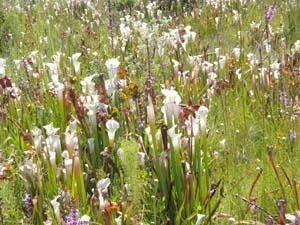
MARLOW, Ala. — The land off County Road 9 had been cleared and appeared barren, except for a 1,000-yard debris pile that was once vegetation on the 13.5-acre site. But in the years since the property was donated to the Weeks Bay Foundation by the late George Skipper and his wife, Mary, of Summerdale, several rare species that once thrived along the Alabama coast have established new life there.
The December 2003 gift of what is now known as the Juniper Bog has since been transferred to the Weeks Bay National Estuarine Research Reserve, which will preserve it in perpetuity. The two organizations, with the help of reserve staff and field botanist Fred Nation, have designed a management plan that assures the habitat will remain conducive to flora (and even fauna) for future generations.
The plan includes prescribed burns, according to Walter Ernest, executive director of the foundation. He said fire suppression over time enabled other plants to overwhelm native species that would otherwise do well in a bog setting.
“It was full of invasive plants, including popcorn trees,” Ernest said. “With the help of the Alabama Coastal Foundation, we planted longleaf and slash pines, along with cypress trees (in the uplands). We then began our prescribed (bog) burning in 2006.”
Field botanist Fred Nation, who lives in Daphne, explained that fire-dependent ecosystems suffer when not allowed to burn on occasion. He said, “Pitcher plants decline if they aren’t burned. They love the sun.”
Eight carnivorous species seem to thrive there now without further assistance. Among them is the very visible, yet rare, white-topped pitcher plant (Sarracenia leucophylia). The once healthy population has been decimated along its coastal range by aggressive residential and commercial development.
“The purple pitcher plant (Sarracenia purpurea) has a big range,” Nation said. “Most are limited to the area of the Gulf Coast. They’re declining in numbers though as their habitat is drained and paved.”
Both he and Harry Larsen, curators of the Weeks Bay Reserve Herbarium, conducted plant surveys at the Juniper property during the summers of 2007, 2008 and 2009.
According to the latest compiled inventory, 59 vascular plant families can be found there, with a total of 137 species. Five of the species are rare or endangered, and one is a hybrid that evolved from two other varieties on the site.
Although the list is quite extensive and detailed, Nation and Larsen noted in the report that it is possible additional species may be found if studies are conducted during other seasons, because many bog plants are ephemeral.
“It’s ironic the bogs are so diverse,” said Margaret Sedlecky, education coordinator at the reserve. “They are some of the poorest soils on the Gulf Coast. It’s an adaptation is our best guess. Growth is relatively slow, and they have reduced competition.”
Many assume insects are the sole food source for the carnivorous species, but that’s not true, Sedlecky pointed out. She said such plants found along the coast are nourished through photosynthesis as are other plants, and the captured bugs merely act as nutritional supplements, much like vitamin tablets.
Also found in fair abundance in the Juniper Bog is the white-fringed orchid (Platanthera blephariglottis), which has been listed by the Alabama Natural Heritage Program as being endangered. There are only two or three historic populations in existence statewide, Nation said.
L.G. Adams, manager of the reserve, added, “These rare plants have an opportunity to come back and get reestablished. (Bogs) are special habitats.”
Ernest agrees. He said, “You don’t just have a pitcher plant bog on every street corner. Because of development, the land is fragmented.”
The foundation has long worked to change that in the Weeks Bay watershed and beyond. Through its fundraising efforts, additional acreage surrounding the parcel donated by the Skippers has been acquired, providing a buffer zone protecting the bog itself from future development.
“They’re all being destroyed in a patchwork manner, and they must be saved the same way,” Sedlecky said, referring to the loss of land considered important as a natural resource.
The Weeks Bay Reserve, a partnership between the state and federal government, currently owns and holds in preservation 6,565 acres, some of which are water bottoms (such as land underneath Weeks Bay and a portion of Bon Secour Bay).
The foundation had previously acquired 684 acres in Mobile County, but have since placed it in Alabama’s Forever Wild land trust program.
“It’s important to maintain as much as we can in the watershed,” Nation said. “The land acts as a sponge and a filter. It filters and holds the water, and plays an important role in water purification.”
These are tidbits of knowledge area schoolchildren have already gleaned. Sedlecky’s position is funded by the Baldwin County Public School System, and through wetland tours, reserve visits and classroom presentations, Sedlecky has helped bring the environmental sciences to life in the eyes of thousands of students so far.
“There’s a big educational value in bogs like this,” Adams said. “There are resources out there needing protection. It shows there’s more than downtown.”
Nation added, “There’s a lot of attention with the charismatics. The thing is not to save the pretty plants, but to save the habitats. The plants will take care of themselves.”
Those who would like to use native species around their own habitat will soon have a chance. The 16th Annual Weeks Bay Native Plant Sale will be held Oct. 9-11, from 9 a.m. until 4 p.m., at Safe Harbor at Weeks Bay. The site is on U.S. Highway 98, across from the Weeks Bay Reserve Interpretive Center.
Shrubs, perennials, butterfly plants, trees, hummingbird plants, as well as varieties found in wetlands and dunes will be available for purchase from volunteers.
Adams credits the foundation, as well as the volunteers who assist the reserve on a daily basis, with the success achieved so far. Ernest welcomes donations of cash and land, in order to help the effort continue.
For more information about the Weeks Bay Reserve, visit www.weeksbayreserve.com. To learn more about the Weeks Bay Foundation, as well as ways to contribute to its mission, visit www.weeksbay.org.