
State environmental officials say the 2007 beach swimming season, which officially ended Sept. 30, was one for the books because of what went right for a change.
The Alabama Department of Environmental Management has reported that a reduced …
This item is available in full to subscribers.
Please log in to continue |
State environmental officials say the 2007 beach swimming season, which officially ended Sept. 30, was one for the books because of what went right for a change.
The Alabama Department of Environmental Management has reported that a reduced number of swimming advisories were issued for public recreational beaches along the Gulf Coast and Mobile Bay.
As part of the Coastal Alabama Beach Monitoring Program, ADEM collected 680 water samples from May through September with testing supporting the issuance of only six advisories.
The swim warnings were issued for five different sites and lasted a total of only 10 days, down from an average of 26 days over the last three years. Alerts issued due to raw sewage spills are not included in the totals.
In a press release, ADEM officials contend the beach monitoring program can serve as a gauge for how well the department’s other programs are working.
“Our beach monitoring program helps the public make informed decisions concerning their recreational use of Alabama’s coastal waters,” stated ADEM Director Trey Glenn. “We have implemented the program to increase public awareness and provide accurate, timely water quality information to beach users.”
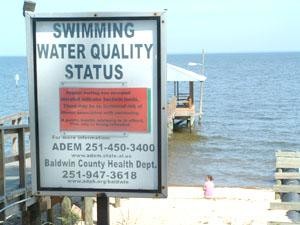
ADEM conducts routine water monitoring at 25 public beaches from Perdido Bay to Dauphin Island. The selection of sites and frequency of sampling are determined using a risk-based evaluation and ranking process.
The monitoring data is published on the ADEM’s Web page and color-coded water quality signs (red, yellow, green) are posted at each monitoring site.
Could the reduction in swimming advisories in 2007 be tied to less rainfall washing fewer pollutants into the bays and inlets? Most of Alabama experienced drought conditions this summer.
Suzi Farr, an environmental scientist in ADEM’s Mobile office, said it’s possible, but there’s currently no way to know for sure.
“Next year part of our grant will cover some bacterial source tracking. We can then find some of the sources,” she said. “Then again, if you look at the sites that had advisories in the past, they are continuing to receive these advisories.”
One trouble spot continues to be Fairhope’s main public beach, where the U.S. Environmental Protection Agency launched an extensive study this summer, exploring how declines in water quality affect the health of those who swim in Mobile Bay.
Farr said, “I’m anxious to see the results of the study.”
She noted that the water quality monitoring program, which operates with the cooperation of the health departments in both of the state’s coastal counties, has also been successful in raising awareness.
“We get a lot of phone calls, even from people coming from out of state,” Farr said. “They call and say ‘our family is going to Gulf Shores or Orange Beach,’ and ask what the water quality is like.”
ADEM doesn’t plan on allowing the program to grow stale. Farr said, “We’re looking at making some changes for next year. Based on the results, Gulf Shores, Orange Beach and Alabama Point never have advisories. We might not sample them as often and instead focus on spots that do have advisories. Maybe the frequencies will change. We’ll meet with the health departments in about a month.”
She pointed out that although this report involves the weekly testing that is conducted from May through September, monthly testing continues from October through April.
“There’s not as many people getting in the water this time of the year,” Farr said.
Alabama’s coastal beaches are one of the state’s major tourist attractions as well as a birthright for residents. The state has around 50 miles of Gulf beaches and an estimated 65-70 miles of bay beaches.
Bacterial contamination in Alabama’s
coastal recreational waters can come from a number of sources, including shoreline development, wastewater collection and treatment facilities, septic tanks, urban runoff, disposal of human waste from boats, swimmers themselves, commercial and domestic animals and natural animal sources.
People who swim in contaminated waters risk exposure to pathogens that can cause serious illness such as ear, eye, skin and respiratory infections, gastrointestinal illness, or even meningitis and hepatitis.
The Coastal Alabama Beach Monitoring Program was implemented in June 1999 with five test sites and was later expanded.


